Tile Pattern Options for Bathrooms: Surrey BC Guide
Which tile pattern suits your bathroom in Surrey, White Rock or Langley? We cover the pros, cons, and most popular options for BC homes in 2026.
Bathroom Tile Patterns: Surrey to Langley 2026
⏱ Estimated Reading Time: 7–8 minutes
You've chosen your tile. You love the colour, the format, the finish. And then your contractor or tile setter asks: what pattern do you want it laid in? For a lot of Surrey, White Rock and Langley homeowners, this is the moment where the decision stalls. It sounds like a minor detail. It isn't.
The pattern your tile is laid in affects how the finished room looks, how large the space feels, how much tile you'll need, how long installation takes, and how well the result holds up over time. A great tile in the wrong pattern can look awkward. The same tile in the right pattern can make a bathroom feel like it was designed by someone who really knew what they were doing.
Here is a clear, honest guide to the most common bathroom tile patterns - what each one does visually, where it works best, its pros and cons, and which ones are performing best in Surrey, White Rock and Langley renovations in 2026.
Straight Stack (Grid) - Simple, Clean, and Unforgiving
A straight stack lays tiles in perfectly aligned horizontal and vertical rows, with all grout lines continuous across the full wall or floor. It's the simplest pattern and the most common default for rectangular and square tiles.
The pros: Clean and contemporary when done well. Works particularly well with large-format tile where the minimal grout lines create the seamless, expansive feel that's defining premium bathroom renovations across the Lower Mainland in 2026. Fast to install and straightforward to quote accurately.
The cons: Requires a perfectly plumb and level wall. Because the grout lines are continuous and perfectly aligned, any deviation in the wall surface or any slight variation in tile sizing is immediately visible. In older Surrey and White Rock homes where walls have settled and are not perfectly square, a straight stack can actually highlight the imperfections it's meant to minimize. A tile setter experienced with older housing stock will assess your walls before committing to this pattern.
Best for: Large-format porcelain tiles (24x48 or larger) on shower walls and bathroom floors where the goal is a seamless, spa-like result. The bigger the tile, the better this pattern works.
Offset / Running Bond - The Workhorse of Bathroom Tile
The offset or running bond pattern staggers each row by half a tile length - the same principle as traditional brickwork. It's the most common tile pattern in residential bathroom renovations across Surrey, White Rock and Langley, and for good reasons.
The pros: Visually familiar and broadly appealing. The staggered joint breaks up any wall unevenness and hides minor subfloor imperfections better than a straight stack. It works with virtually every tile size - from classic 3x6 subway tile to larger formats - and with any design direction from contemporary to traditional. It's also the most widely understood pattern among tile setters, which means consistent results.
The cons: The traditional 50% offset (half-brick) can cause "lippage" - where the edge of one tile sits slightly higher than the adjacent tile - when used with large-format tiles on walls. This is a technical installation challenge rather than a design flaw, but it's worth knowing. For tiles larger than 12 inches in length, a reduced offset of 25% to 33% is often recommended to minimise this risk. Your tile setter will advise on the appropriate offset for the specific tile you've chosen.
Best for: Subway tile in classic 3x6 or elongated formats, where it's the natural and expected pattern. Also works well with larger rectangular tiles in bathrooms where a straight stack is too demanding of the wall surface.
Herringbone - The Pattern That Adds the Most Visual Movement
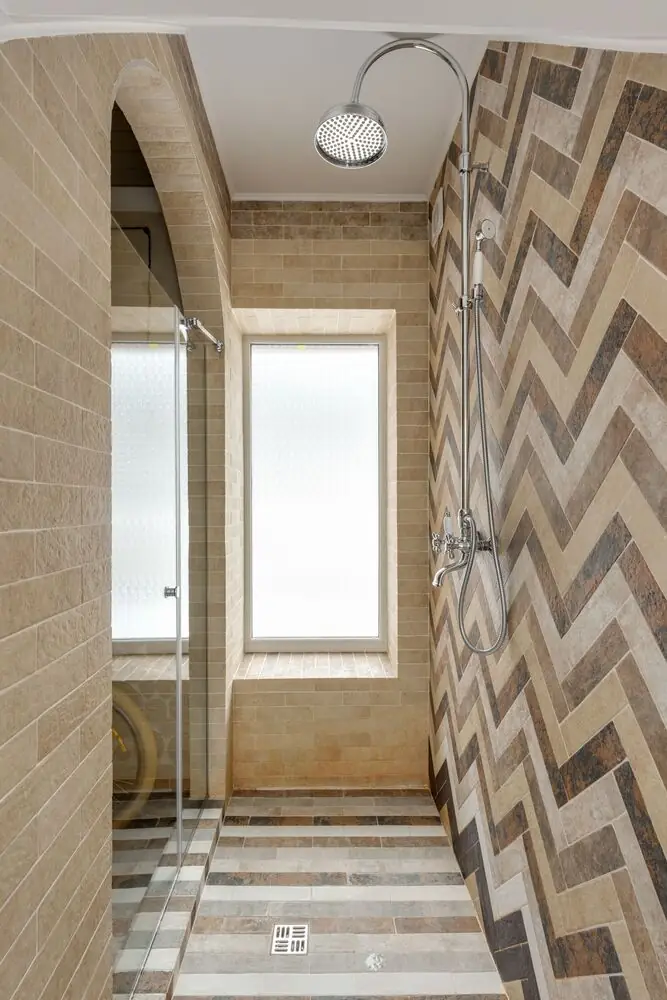
Herringbone arranges rectangular tiles at 90-degree angles to each other in a V-shape, creating a continuous zigzag pattern across the surface. It's one of the oldest tile patterns in existence and one of the most consistently requested in Surrey, White Rock and Langley bathroom renovations in 2026.
The pros: Herringbone adds visual interest and movement to a surface without adding colour or texture. It makes small spaces feel more dynamic and considered - a bathroom tiled in herringbone reads as intentionally designed rather than defaulted into. It works beautifully in both traditional and contemporary directions depending on the tile choice, and it's particularly effective on bathroom floors where the pattern is fully visible.
The cons: Herringbone requires significantly more cutting than a straight stack or offset pattern - particularly at edges and corners where the pattern meets a wall. This adds installation time and increases tile waste - typically 10 to 15% more tile is needed compared to a straight lay. The pattern is also more demanding to set level and align correctly, which means it takes longer and should only be quoted by tile setters with experience in the pattern.
Best for: Bathroom floors in medium to large format tile. Feature walls in a shower or behind a freestanding tub. Elongated subway and brick-format tiles where the directional movement of the pattern is most pronounced.
Chevron - The More Precise Cousin of Herringbone
Chevron is similar to herringbone at first glance - both create a V-shape pattern - but there's an important difference. In herringbone, standard rectangular tiles meet at 90-degree cuts at the point of the V. In chevron, the tiles are cut at an angle so the V-point meets precisely, creating a continuous, uninterrupted arrow shape.
The pros: Chevron is more refined and precise-looking than herringbone. The clean, continuous V-point creates a sharper, more tailored effect. It's a pattern that reads as genuinely high-end when executed well, and it's trending strongly in premium bathroom renovations in South Surrey and White Rock in 2026.
The cons: Chevron requires specially cut tiles - you cannot create a true chevron with standard rectangular tiles. This means either ordering purpose-cut chevron tiles (which are available from most Lower Mainland tile suppliers) or having tiles cut on site, both of which add cost. Installation is more complex and slower than herringbone, and waste is higher. It's a pattern that rewards a skilled, experienced tile setter and budget that supports the additional labour.
Best for: Feature walls in premium master ensuite renovations. Shower floors in smaller format tile. Any application where the additional cost and complexity is justified by the design statement it creates.
Diagonal / Diamond - Expanding Small Spaces
A diagonal or diamond pattern lays square or rectangular tiles at a 45-degree angle to the walls, with the points of the tile facing up, down, and to the sides. It's a classic pattern with a specific and reliable visual effect.
The pros: The diagonal line draws the eye across the space at an angle, which makes small bathrooms feel noticeably larger than a grid or offset pattern. This is the pattern's primary practical value in the context of Surrey, White Rock and Langley's significant stock of smaller bathrooms in townhouses and older detached homes. It's also a pattern with genuine visual longevity - it reads as classic rather than trend-specific.
The cons: The 45-degree angle creates a significant amount of cutting at every wall edge, which increases waste and installation time. Cutting floor tiles at exact angles to fit neatly against skirting boards and fixtures is painstaking work that separates experienced tile setters from less careful ones. Budget 15 to 20% extra tile for waste on a diagonal installation.
Best for: Small bathroom floors where the space-expanding visual effect is the primary goal. Main bathroom and ensuite floors in homes from the 1980s and 1990s in Surrey and Langley where compact bathroom footprints are common.
Large-Format Continuous / Tile Drenching - The 2026 Statement
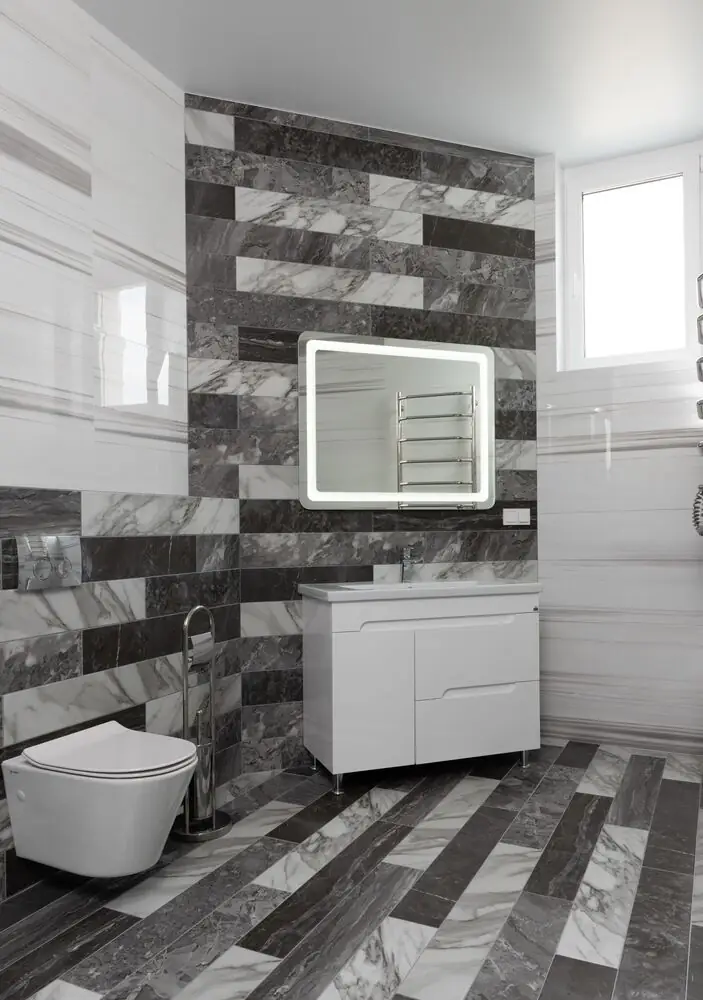
One of the strongest tile direction trends in 2026 - both nationally and specifically in the Lower Mainland - is "tile drenching." This isn't a pattern in the traditional sense, but a design approach: using the same large-format tile continuously across the floor, shower walls, and ceiling of a bathroom without any change in material at transitions.
The pros: The visual effect of a bathroom where the same tile flows uninterrupted from floor to wall to ceiling is genuinely striking. It creates a spa-like immersive quality that no amount of fixtures or fittings can replicate, and it makes the space feel larger by eliminating every visual break that separate materials create. In premium master ensuite renovations in Surrey's South end and White Rock, tile drenching is the direction that renovation photography is built around right now.
The cons: The tile selection has to be right - a tile that works beautifully as a floor feature may feel overwhelming when it covers every surface. Warm neutral tones in matte or satin finish are the most versatile choice for drenching because they're immersive without being overpowering. It's also a significant amount of tile, so material costs are higher than a selective application, and the installation scope is larger.
Best for: Master ensuite renovations in South Surrey, White Rock and Langley's premium market where the goal is a fully resolved, premium result that competes with the best renovation photography in the Lower Mainland.
Checkerboard - Back and Better Than Before
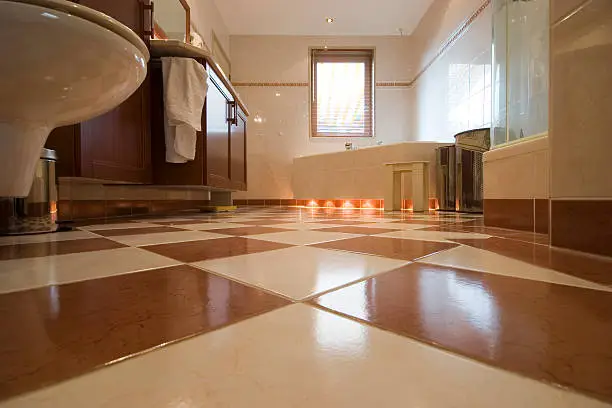
The checkerboard pattern - alternating two contrasting tiles in a grid - has made a genuine comeback in 2026, appearing in bathroom renovations across the Lower Mainland in softer, more refined versions than the bold black-and-white iterations of previous decades.
In 2026, the checkerboard interpretations that are working best are softer pairings - cream and warm grey, white and sage, off-white and terracotta - that create the visual rhythm of checkerboard without the high contrast that dates quickly. In powder rooms and small main bathrooms, a soft checkerboard floor with a simple white or neutral wall tile is one of the most charming and personality-rich combinations available at any price point.
Costs and What to Ask Your Tile Setter
Complex patterns cost more to install than simple ones - both in labour time and in tile waste. Here is a general guide to installation complexity and its impact on cost in Surrey, White Rock and Langley's current market:
Straight stack or offset: baseline installation cost - lowest complexity, least waste. Herringbone: typically 15 to 25% higher labour cost than offset, plus 10 to 15% additional tile for waste. Chevron: typically 25 to 35% higher labour cost than offset, purpose-cut tiles required. Diagonal: typically 15 to 25% higher labour cost, plus 15 to 20% additional tile for waste. Tile drenching: higher material cost from increased tile volume, installation complexity varies by scope.
Before finalising your tile pattern selection, confirm with your tile setter that they have experience with the specific pattern you've chosen and ask them to show examples of completed work. A straight stack looks very different in photos from a herringbone or chevron - and the difference in execution quality between an experienced and an inexperienced tile setter is always most visible in complex patterns.
For a full guide to the best tile materials for bathroom showers and floors in our area, what is the best tile for a bathroom shower in Surrey and White Rock covers the material decisions that work alongside pattern selection.
Final Thoughts
The tile pattern you choose is one of the most lasting design decisions in a bathroom renovation - it stays for the life of the tile, which in a quality BC bathroom is 20 to 40 years. Choosing based on what looks good in the showroom is not enough - the pattern needs to suit your specific tile format, your bathroom's dimensions, your wall conditions, and your contractor's capability to execute it well. For most Surrey, White Rock and Langley homeowners in 2026, a large-format straight stack delivers the most premium result with the least risk. For those who want more personality and movement, herringbone is the most reliable and broadly appealing choice at any price point.


