Kitchen Lighting Ideas Surrey, White Rock & Langley 2026
Kitchen lighting ideas for Surrey, White Rock or Langley? We cover layered lighting, pendant lights, under-cabinet LEDs, costs, and 2026 BC trends.
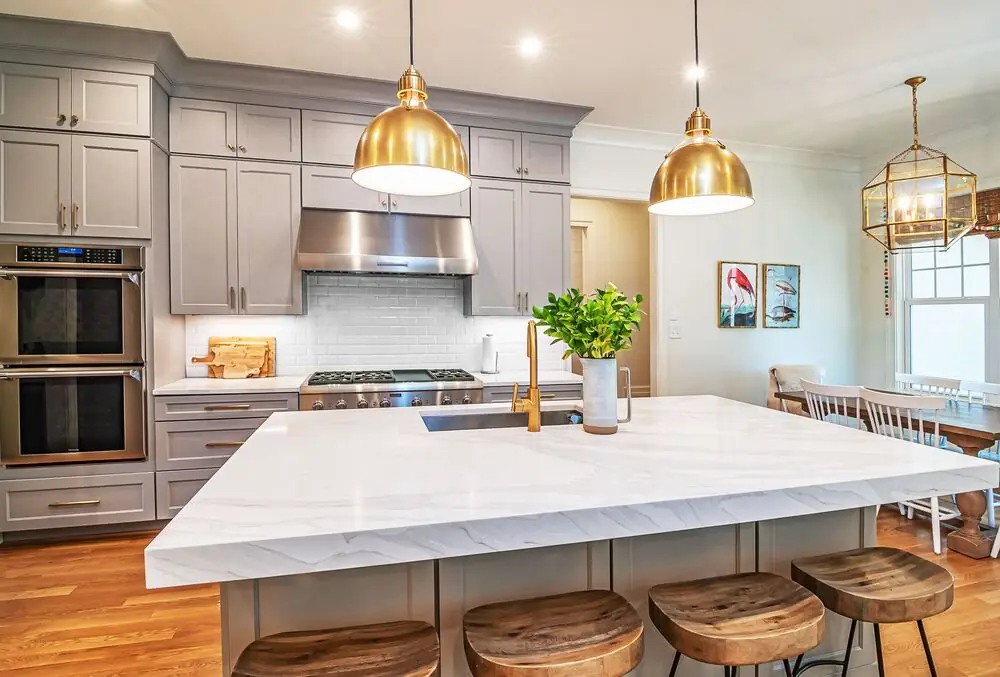
What Is the Best Kitchen Lighting for Surrey, White Rock and Langley Homes in 2026?
⏱ Estimated Reading Time: 6–7 minutes
There's a specific feeling you get walking into a kitchen that's lit well. It's warm without being dim. Bright where you need it, softer where you don't. The island feels like a destination. The countertops are clearly lit for work. And when you turn on the dimmer for dinner, the whole room settles into something that feels genuinely comfortable rather than clinical.
Most Surrey, White Rock and Langley kitchens don't feel like that. They have pot lights - maybe too many, maybe not in the right spots - and nothing else. It's bright and flat and a bit harsh, like a supermarket rather than a room you want to spend time in.
The difference between a kitchen that looks great and one that feels great is almost always lighting. Here's how to get it right in 2026.
Why One Light Source Is Never Enough
This is the most important principle in kitchen lighting, and it's the one most commonly overlooked.
A kitchen lit by a single source - even a grid of pot lights across the ceiling - produces light that comes from one direction. Everything below that source casts a shadow. You stand at the counter and your own body blocks the light from reaching your workspace. The result is that you're cooking in your own shadow, which is annoying and unsafe in ways you get used to and then notice immediately when you're in a better-lit kitchen.
Layered lighting solves this by bringing light from multiple directions and at multiple heights - above, in front, and to the side of where you're working. The three layers are:
Ambient lighting - the background brightness that lets you move around the kitchen safely. Recessed pot lights, flush-mount ceiling fixtures, and LED panel lights handle this. They light the room generally without specifically illuminating any work surface.
Task lighting - directed light that falls exactly where you work. Under-cabinet LED strips for the countertop. Pendant lights over the island. A downlight directly above the sink. This is the layer that makes prep and cooking actually comfortable to do.
Accent lighting - the layer that makes the kitchen feel considered rather than purely functional. Inside glass-door cabinets. Above upper cabinets (toekick lighting). A picture light on a decorative element. This layer is optional but it's what separates a kitchen that works from one that feels genuinely special.
Recessed Pot Lights - Getting the Placement Right
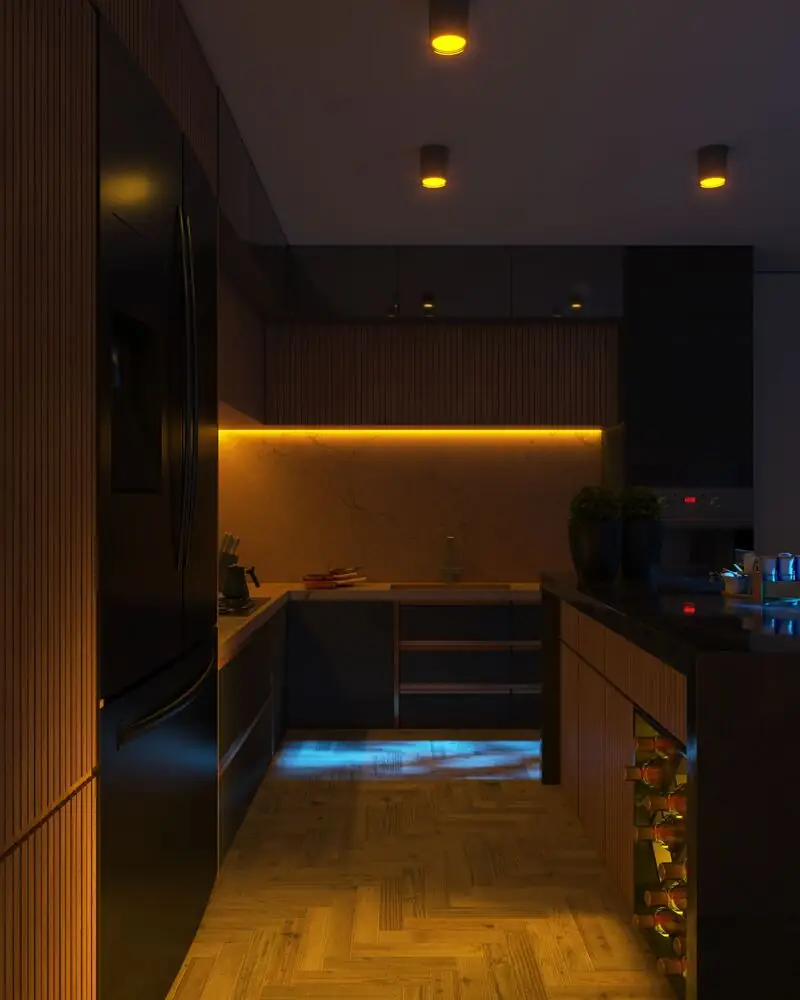
Pot lights are the ambient foundation of most Surrey, White Rock and Langley kitchen lighting schemes, and they work well when they're placed correctly. The common mistake is either too many, or the wrong spacing.
For an 8-foot ceiling, space pot lights approximately 1.2 metres (4 feet) apart. For a 9-foot ceiling, approximately 1.4 metres (4.5 feet). Keep the first row 60 to 90 cm (2 to 3 feet) from the wall so the light falls on the countertop below the upper cabinets rather than on the upper cabinet faces themselves.
Colour temperature matters significantly in a kitchen. Warm white (2700K to 3000K) feels inviting and works beautifully in open-concept kitchens where the kitchen is visible from the living area. Neutral white (3500K to 4000K) is the most balanced choice for cooking - clear and comfortable without feeling clinical. Cool white (5000K and above) is bright and sharp but can feel hospital-like in a residential kitchen.
For most Surrey, White Rock and Langley kitchens in 2026, 2700K to 3000K is the right choice - warm enough to feel like a living space, bright enough to cook comfortably.
Under-Cabinet LED Lighting - The Upgrade That Changes Everything
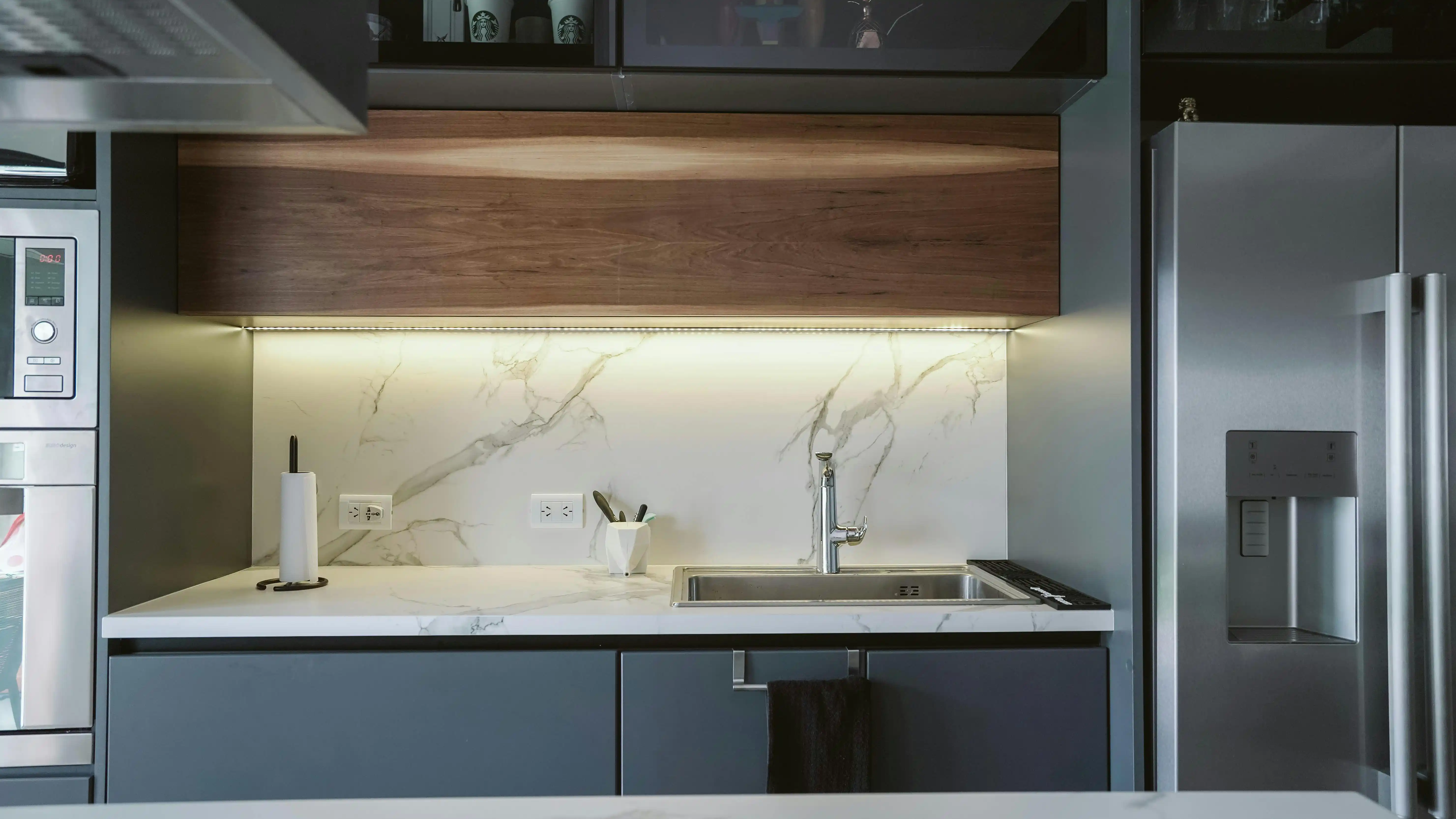
Under-cabinet LED strip lighting is consistently the single most impactful kitchen lighting upgrade for the cost, and it's one of the most consistently appreciated additions in completed renovations across our area.
The light source is positioned right above your work surface - it comes from in front of you rather than behind you, so there are no shadows on your cutting board or prep area. It illuminates the backsplash beautifully, which is why well-lit kitchens always seem to make their backsplash tile look better than it does in daylight - the light from below is revealing the tile in a way that overhead ambient light simply cannot.
For a full kitchen renovation where electrical work is already in scope, hardwired under-cabinet LED strips with a dimmer are the premium choice - no visible cords, clean installation, and full brightness control. The cost runs $1,300 to $2,800 CAD for a standard kitchen depending on the linear footage of upper cabinets. For a more detailed guide including plug-in options and installation costs, what is under-cabinet lighting and is it worth adding to your Surrey or White Rock kitchen covers everything.
Pendant Lights Over the Island - Scale, Spacing, and Style
Pendant lights over the kitchen island are the most visible and design-forward lighting element in a kitchen renovation. They're also the most commonly done wrong - undersized, poorly spaced, or out of proportion with the island below them.
Height: Hang pendants 75 to 90 cm (30 to 36 inches) above the island countertop surface. If your ceiling is higher than 9 feet, add 7 to 10 cm per additional foot of ceiling height. This is the height where pendants provide good task lighting without obstructing sightlines across the island.
Spacing: For an island up to 1.2 metres (4 feet) long, two pendants spaced evenly. For 1.5 to 1.8 metres (5 to 6 feet), two to three pendants. For larger islands over 1.8 metres, three or more. The pendants should span approximately two-thirds of the island's length, centred over it.
Scale: This is where most pendant choices go wrong. A pendant that looks the right size in a showroom can look lost over a large island. Generally, the pendant diameter or width should be 12 to 18 inches for a single pendant and 8 to 12 inches each for multiple pendants. For long linear islands, a single elongated linear pendant spanning the island length is increasingly popular in 2026.
Style in 2026: The pendant finishes and forms that are resonating most strongly in Surrey, White Rock and Langley kitchens in 2026 are brushed brass and aged bronze for warm, transitional kitchens - they pair naturally with warm wood cabinetry and zellige backsplash. Matte black pendants for contemporary and two-tone kitchens - the contrast against light cabinetry is crisp and confident. Fluted glass pendants are the more decorative choice gaining traction, particularly over islands with warm countertop materials. Clear glass globes are fading - they feel dated relative to the more textured and material-forward options now available.
The key principle with pendants: choose a finish family and repeat it in at least two other elements in the kitchen - tapware, cabinet hardware, or other fixtures. This is what makes a lighting choice feel intentional rather than randomly selected.
What's Heading Out in 2026
A few lighting approaches that experienced designers and contractors in the Lower Mainland are moving away from:
A single-source kitchen - only pot lights, nothing else. It produces flat, shadowless light that reads as institutional.
Undersized single pendants over islands. Scale matters, and a pendant that's too small for the island it hangs over looks like an afterthought rather than a design decision.
Polished chrome fixtures. The chrome kitchen lighting era is effectively over in our area - brushed finishes in nickel, brass, bronze, and matte black have replaced it across the board.
Fluorescent strip lighting under cabinets. Still found in older Surrey and Langley homes that haven't been renovated. LED strips are warmer, more energy-efficient, and significantly better-looking.
Permit and Electrical Requirements in Surrey, White Rock and Langley
Any new electrical circuit, additional light fixture locations, or changes to the electrical panel require a permit and a licensed electrician. In Surrey, the permit goes through the MySurrey portal. In White Rock, through the City of White Rock Building Department (building@whiterockcity.ca or 604-541-2149). In the Township of Langley through the Development Services Department and the City of Langley through the Community Development Department.
Dimmers require LED-compatible dimmer switches - not all dimmers work with all LED products. Confirm compatibility with your electrician before purchasing either the LED fixtures or the dimmer switches. An incompatible dimmer causes flickering, buzzing, and incomplete dimming - all of which defeat the purpose of installing dimmers in the first place.
What Does Kitchen Lighting Cost in Surrey, White Rock and Langley?
A complete layered kitchen lighting installation - pot lights spaced correctly, hardwired under-cabinet LED strips with dimmer, and pendant lights over the island, all with properly permitted electrical work - typically runs $3,200 to $6,400 CAD in the current Lower Mainland market for a standard kitchen. This includes electrical labour at current Surrey and Langley trade rates, permit fees, and quality LED fixtures.
This scope is most cost-effectively done as part of a kitchen renovation where electrical is already in scope. As a standalone lighting upgrade in a finished kitchen, the need to open ceilings and walls for wiring pushes the total higher. For broader kitchen renovation planning context, kitchen renovation planning guide for Surrey, White Rock and Langley homeowners covers how electrical planning fits into the full renovation sequence.
Final Thoughts
The best kitchen lighting for a Surrey, White Rock or Langley home in 2026 is layered - ambient pot lights, task-focused under-cabinet LEDs, and pendant lights over the island working together rather than one source trying to do everything. The colour temperature should be warm white (2700K to 3000K) for a kitchen that feels like a living space. Pendant finishes should align with the cabinet hardware and tapware. And everything should be on dimmers - the ability to shift from bright work lighting to a warmer dinner atmosphere with one slider is one of those details that changes how a kitchen feels every evening.


