Kitchen Corner Cabinet Solutions: Surrey & White Rock
Blind corners waste kitchen storage. Compare lazy Susans, pull-outs, corner drawers and more to make every corner work in your Surrey or White Rock kitchen.
Kitchen Corner Cabinet Solutions for Surrey and White Rock Homes
⏱ Estimated Reading Time: 5–6 minutes
Every L-shaped and U-shaped kitchen has the same problem hiding in it: the corner. Where two runs of cabinets meet, there's a deep, awkward space that's hard to reach and easy to forget about. In many older Surrey and White Rock kitchens, that corner is a dark cave where pots, small appliances, and mismatched containers go to disappear. A renovation is the moment to fix it, and there are more good options than most homeowners realize.
Why Corners Are the Hardest Storage in a Kitchen
A standard base cabinet is about 24 inches deep, so where two runs meet at a right angle, the corner creates a square of space roughly two feet by two feet that sits behind the cabinets on either side. With a basic blind corner cabinet, you reach that space through a narrow door and then stretch into the dark to find what you need. The upper cabinets have the same problem on a smaller scale. The goal of any corner solution is to bring that hidden space out to where you can see and reach it, or to make a deliberate decision about how to use it.
Lazy Susans
The lazy Susan is the classic corner solution and still one of the most practical. Rotating shelves let you spin stored items to the front instead of reaching for them. Full-round versions sit in a corner cabinet with a diagonal front, while pie-cut versions use an L-shaped door that folds inward. Lazy Susans are reliable, relatively affordable, and good for mid-size items like pots, mixing bowls, and pantry goods. Their weakness is that round shelves in a square cabinet leave unused space in the corners of the corner, and smaller items can fall off the back of the shelves.
Blind Corner Pull-Outs
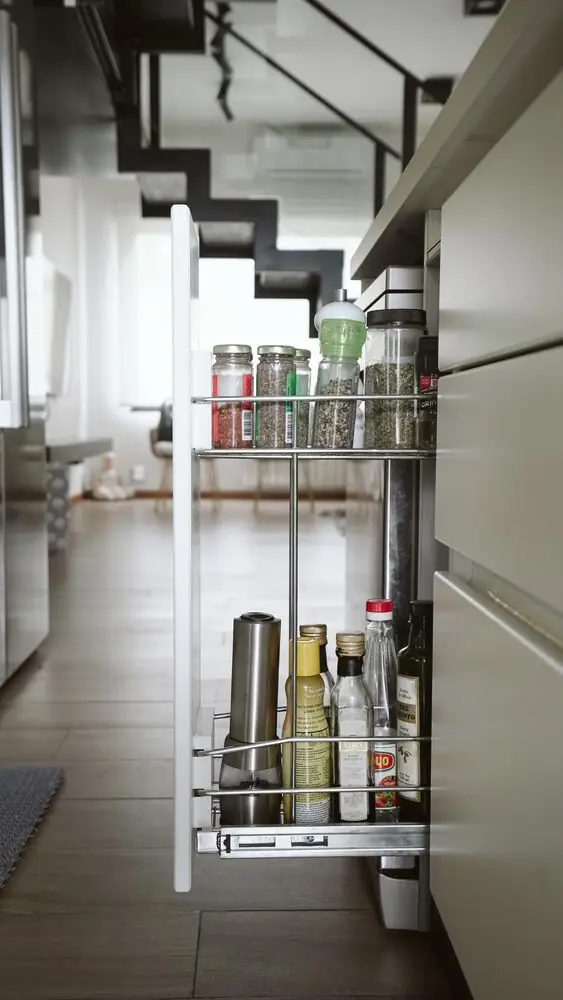
For a blind corner, where one cabinet run butts into the side of another, swing-out mechanisms bring the hidden space into the open. Kidney-shaped swing-out shelves, often called LeMans units, pivot out of the cabinet as you open the door. Two-part systems, sometimes called magic corners, pull the front shelves out first and then slide the rear shelves forward into the opening. These make a blind corner almost fully usable and are excellent for heavy pots and pans, but they're one of the more expensive cabinet upgrades, and they need the cabinet to be sized to suit the specific mechanism.
Corner Drawers
Corner drawers are a newer and very effective option. Instead of a door, the corner cabinet gets V-shaped drawers that pull straight out on the diagonal, using the full depth of the corner. Drawers are generally easier to use than shelves anywhere in a kitchen, since everything is visible from above, and the same holds true in the corner. Corner drawers usually require custom or semi-custom cabinetry. For more on organizing cookware specifically, our guide to storing pots and pans covers the options throughout the kitchen.
Upper Corner Options
Upper corners are less of a problem because they're shallower, typically around 12 inches deep, but they still waste space when the cabinets on either side simply meet. A diagonal upper corner cabinet gives you a larger, deeper cabinet with a full-width door, and it can hold a small lazy Susan for spices or glassware. Open corner shelves are another option that suits a lighter, more open look, and they're well suited to items you use every day. A corner can also be a natural spot for an appliance garage on the counter below, keeping the toaster or coffee maker out of sight.
When to Give Up the Corner on Purpose
Sometimes the best solution is to stop fighting the corner. If the space behind an L-shaped run backs onto an island, a dining area, or an adjoining room, you can access the corner from the other side with a cabinet or open shelf facing that space. In other kitchens, it makes sense to accept a simple blind corner cabinet for rarely used items, like holiday platters or a turkey roaster, and put the budget into better storage elsewhere. And in some layouts, placing the sink or range on a diagonal across the corner turns the awkward space into a working zone, though that changes the whole layout and usually only makes sense in a larger kitchen.
Plan the Corners During Design
Corners are where small measuring errors cause the biggest problems. Doors and drawers on either side of the corner need clearance so they don't collide with each other or with handles, which is why corner cabinets usually include filler strips of a few inches. Appliances near the corner need room for their doors to open fully, and a dishwasher placed tight to a corner can block the cabinet next to it. Getting these details right at the design stage avoids headaches later. Our guide to standard kitchen cabinet measurements covers the dimensions that matter, and our guide to kitchen cabinet ideas covers the broader design choices.
Choosing the Right Solution
The right corner solution depends on what you need to store and how you cook. If you want a reliable, budget-friendly fix for pots and pantry items, a lazy Susan works well. If you have a blind corner and want to use every inch for heavy cookware, a swing-out or two-part pull-out is worth the investment. If you're going custom and prefer drawers throughout, corner drawers are the most efficient option. And if the corner can be reached from another side, opening it up there may be the simplest answer of all.
Final Thoughts
The kitchen corner doesn't have to be wasted space. Lazy Susans, blind corner pull-outs, corner drawers, diagonal uppers, and smart layout decisions can all turn the hardest-to-reach part of an L-shaped or U-shaped kitchen into storage you actually use. The time to solve it is during the design of a Surrey or White Rock kitchen renovation, when cabinet sizes, clearances, and mechanisms can be planned together rather than squeezed in afterward.


