Kitchen Countertop Edges: Guide for Surrey Homeowners
Choosing a countertop edge in Surrey or White Rock? We explain every profile, what it costs, and which works best for your kitchen renovation.
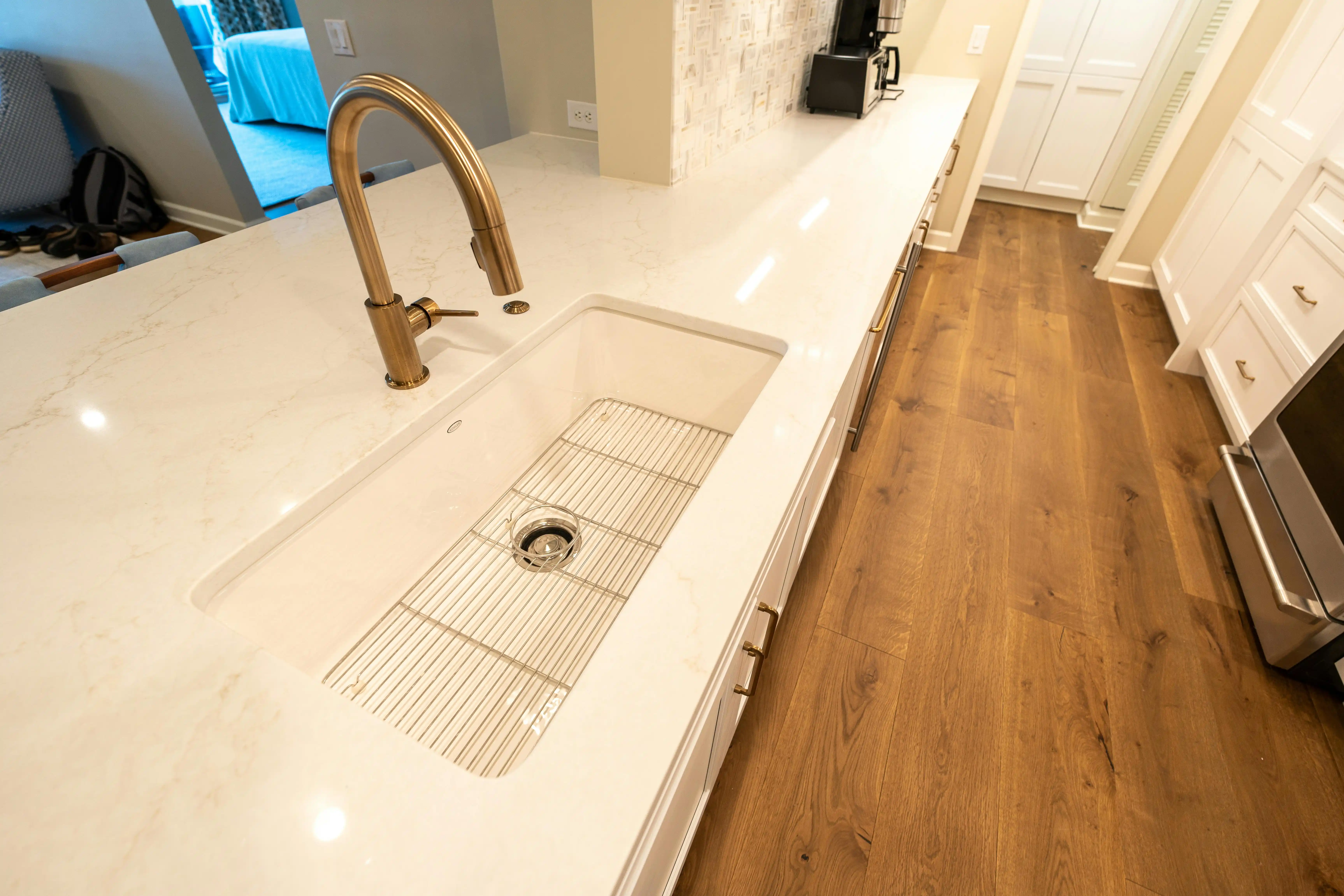
Kitchen Countertop Edge Profiles Explained for Surrey and White Rock Homeowners
When Surrey and White Rock homeowners start planning a kitchen renovation, countertop material and colour tend to get all the attention. But there is one detail that often gets decided in the final five minutes of a showroom visit - the edge profile - and it has a bigger impact on the finished look than most people expect. If you are still in the early stages of planning, it is worth reading 'What Material Is Best For Kitchen Countertops?' before getting into edge selection - understanding your slab choice first makes the edge decision much clearer.
An edge profile is the shape given to the exposed outer edge of your countertop. It is where your hands rest every time you stand at the counter, and it frames the entire surface visually. The right choice can make a countertop look sleek and contemporary or classic and substantial. The wrong one can date an otherwise well-designed kitchen faster than almost any other decision. Here is what Surrey and White Rock homeowners need to know before signing off on an edge.
⏱ Estimated Reading Time: 8–9 minutes
What Is a Countertop Edge Profile and Why Does It Matter?
A countertop edge profile is the shape and finish applied to the visible edge of your stone or engineered stone slab. It is created during the fabrication process, typically using a CNC router or hand finishing, depending on the complexity of the profile. Some profiles are simple and included in the base fabrication cost. Others are more involved and carry an additional charge.
Beyond aesthetics, edge profiles affect day-to-day practicality. Some profiles are easier to clean than others. Some are more prone to chipping at the corners. Some add a sense of visual thickness to a slab, which can elevate the perceived quality of the countertop. And in households with young children in Surrey and White Rock homes, the safety implications of sharp versus rounded profiles are worth considering.
The Most Common Edge Profiles and What They Deliver
Eased Edge
The eased edge is the most widely specified profile in Surrey and White Rock kitchen renovations and for good reason. It features a flat top, flat sides, and very slightly softened corners - not fully rounded, but with enough relief that sharp edges are eliminated. It is clean, versatile, and works with virtually every kitchen design from contemporary to transitional.
In most fabrication shops serving the Lower Mainland, the eased edge is included in the base slab cost with no upcharge. For homeowners who want a precise, modern look without paying a premium, it is consistently the right call. It is also the easiest profile to keep clean, with no grooves or curves to trap debris.
Bevelled Edge
A bevel introduces an angled cut - typically at 45 degrees - along the top edge of the countertop. It adds a subtle geometric detail that reads as slightly more designed than a plain eased edge, while still remaining clean and contemporary. Bevelled edges are particularly popular in transitional kitchens across South Surrey and White Rock where the design falls between modern and traditional.
In the Lower Mainland market, a bevel edge typically carries an upcharge over a standard eased edge - usually in the range of $15 to $55 CAD per linear foot depending on the fabricator.
Bullnose and Half-Bullnose
A full bullnose edge is rounded on both the top and bottom, creating a smooth, curved profile all the way around. It has a softer, more traditional feel and is particularly well-suited to family kitchens where young children are regularly at counter height. The rounded profile eliminates hard corners entirely, which reduces the risk of injury from bumped hips or elbows - a practical consideration in busy Surrey households.
The half-bullnose keeps the rounded top but leaves a flat, square bottom edge. It provides most of the safety benefit of the full bullnose with a slightly crisper look from the front.
Both profiles carry a modest upcharge over a standard eased edge. They also require slightly more attention when cleaning around the curved underside, but the trade-off in comfort and safety is worth it for many families.
Waterfall or Mitered Edge
The waterfall or mitered edge is one of the most striking options available and has become a standout feature in higher-end Surrey and White Rock kitchen renovations. In this profile, the countertop slab continues vertically down the side of a kitchen island, creating an unbroken surface from the top all the way to the floor. Two pieces of stone are joined at a precise 45-degree mitered angle to create the illusion of a single, continuous slab.
The visual effect is exceptional - it showcases the veining of a premium quartz slab in a way no other edge can match, and it gives a kitchen island a sculptural, furniture-like presence. The cost reflects the additional fabrication and material required. In Surrey and White Rock, a waterfall island edge typically adds $2,500 to $5,000 CAD or more to the overall countertop cost, depending on the height of the drop, the number of sides involved, and how well the veining needs to be matched. It is an investment, but for homeowners doing a premium kitchen renovation it delivers one of the highest-impact results of any single decision.
Ogee Edge
The ogee is a traditional S-shaped profile that adds ornamental detail to a countertop edge. It was widely popular in the early 2000s and remained a go-to choice for traditional kitchens through the 2010s. In 2026, it reads as more dated in contemporary Surrey and White Rock renovation contexts, though it remains appropriate for very traditional or heritage-style kitchen designs where the cabinet detail is similarly ornate.
If your kitchen design is modern or transitional, the ogee profile is generally not the right choice - it can feel out of place against flat-panel cabinetry or clean quartz surfaces. An experienced kitchen designer will typically steer you away from it unless the broader design truly supports it.
How Edge Profiles Affect Cost in Surrey and White Rock
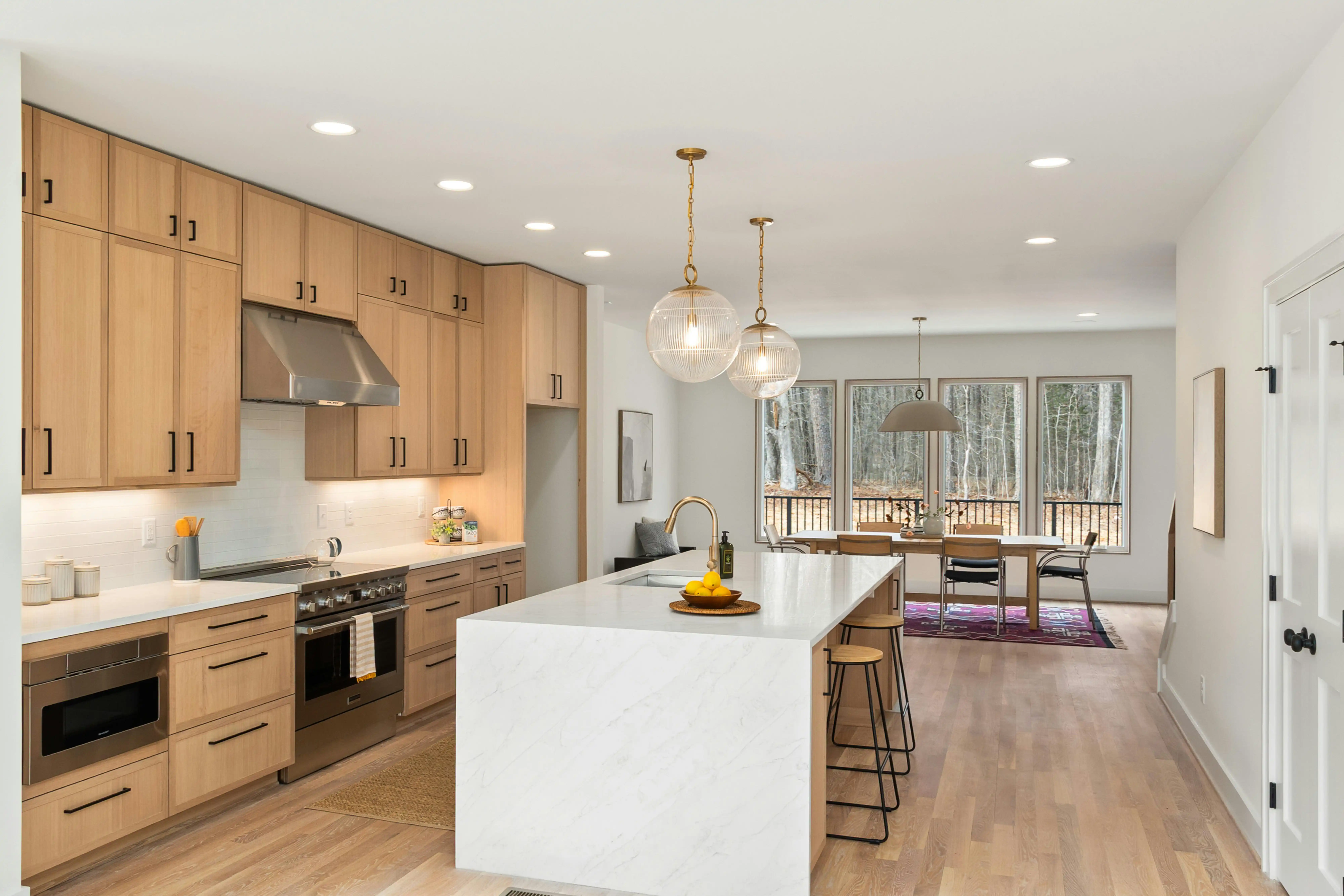
Waterfall quartz countertop kitchen island renovation White Rock BC
In the Lower Mainland fabrication market, the cost difference between a standard eased edge and a premium profile is typically measured per linear foot of countertop edge. Simple profiles like eased and bevel are generally included in the base fabrication cost or carry an upcharge of $15 to $55 CAD per linear foot. More complex profiles like ogee, double ogee, or mitered edges run $35 to $80 CAD per linear foot or more. Waterfall edges are priced as a separate scope item, not per linear foot.
For a typical Surrey or White Rock kitchen with roughly 15 to 20 linear feet of countertop edge, the difference between a standard eased profile and a premium ogee or laminated profile is usually $250 to $1100 CAD - a modest investment relative to the overall kitchen budget. The waterfall edge is the exception, as noted above, where the cost is meaningfully higher. For a full picture of what drives kitchen renovation costs in our area, the kitchen renovation cost guide for Surrey and White Rock breaks down where the budget actually goes.
Matching Your Edge to Your Kitchen Design
The most reliable approach to edge selection is to match the profile to the style of your cabinetry and the overall design direction. Flat-panel, handleless, or Shaker-style cabinetry - which dominates the Surrey and White Rock renovation market in 2026 - pairs most naturally with clean, geometric profiles like eased, bevel, or mitered. Ornate or raised-panel cabinetry in a traditional kitchen can accommodate a bullnose or modest ogee. Premium natural or engineered stone with strong veining benefits from a waterfall or mitered edge that showcases the material rather than hiding it.
If you are renovating a kitchen you plan to sell within the next few years, the eased or bevel edge is the safest choice - it appeals to the broadest pool of buyers in the current South Surrey and White Rock market and is unlikely to date quickly. For broader guidance on which renovation decisions add the most resale value, see what renovations add the most value to a home in Surrey and White Rock.
Final Thoughts
A countertop edge profile might be one of the last decisions you make in a kitchen renovation, but it should not be an afterthought. The right profile ties the entire countertop surface together, complements your cabinetry, and sets the tone for how modern, traditional, or premium the finished kitchen feels. Take a few extra minutes in the showroom to look at profiles in person, and ask your fabricator to show you samples in your chosen stone - what looks good in a photo does not always translate the same way in the actual material.


